

At Eskew Law, our Indianapolis paternity lawyers fully understand Indiana law and recognize that parents are afforded legal responsibilities regarding the care of their children. Oftentimes, paternity needs to be established before bestowing the rights and obligations of parenthood upon a father.

Establishing paternity may involve testing and court procedures. Once paternity is established, the father can pursue his rights or be ordered by the court to pay child support. Establishing paternity allows a child to be fully cared for by both parents and to receive the basic needs required for his or her upbringing, such as food, shelter, and education.

If you believe you have rights as a biological father and want to pursue those rights or if you are disputing the paternity of a child, you need a skilled Indianapolis family law legal practitioner to evaluate your situation, advise you on how to proceed, and advocate for your side in court. Alternatively, if you seek to establish the paternity of your child, our Indiana paternity lawyer can help.
To learn more about the law and your rights, contact Eskew Law today. Our family law litigators can assist you with paternity, child custody and visitation, and child support issues. To schedule a consultation, call us. Your family’s future is our focus.
If paternity is not presumed, there are several situations in which the mother or alleged father may want to pursue a paternity action.
At Eskew Law, regardless of why you want to pursue a paternity action, our skilled Indiana paternity attorney can help.
The first thing to understand about Indiana paternity laws is that when a married woman gives birth to a child the Indiana paternity statute law presumes that the mother’s husband is the biological father of the child. In addition, if a couple separates or files for divorce and a child is born less than 300 days later, the ex-husband is presumed to be the father. Therefore, he is given legal rights and has an equal say in the care and upbringing of the child, unless the presumption is rebutted.
However, in some situations, a husband is not the biological father and may contest paternity. In other situations, the purported parents are not a couple. Therefore, the court intervenes to determine paternity. To do so, courts rely on Indiana paternity laws, which our dedicated Indianapolis lawyer could help you navigate.
The first way to establish paternity is to file a paternity affidavit under Indiana Code § 16-37-2-2.1. A paternity affidavit is a declaration, signed by both the man and woman, that the man is the biological father. Usually, this affidavit is done at the hospital after the child is born, though it can be executed at any time while the child is a minor. Once the affidavit is signed and submitted to the Indiana State Department of Health, the man will be listed as the father on the birth certificate. Of course, if paternity is contested, it is unlikely that both parties will agree to sign the affidavit. Thus, for most people seeking to establish paternity, this option is of little help.
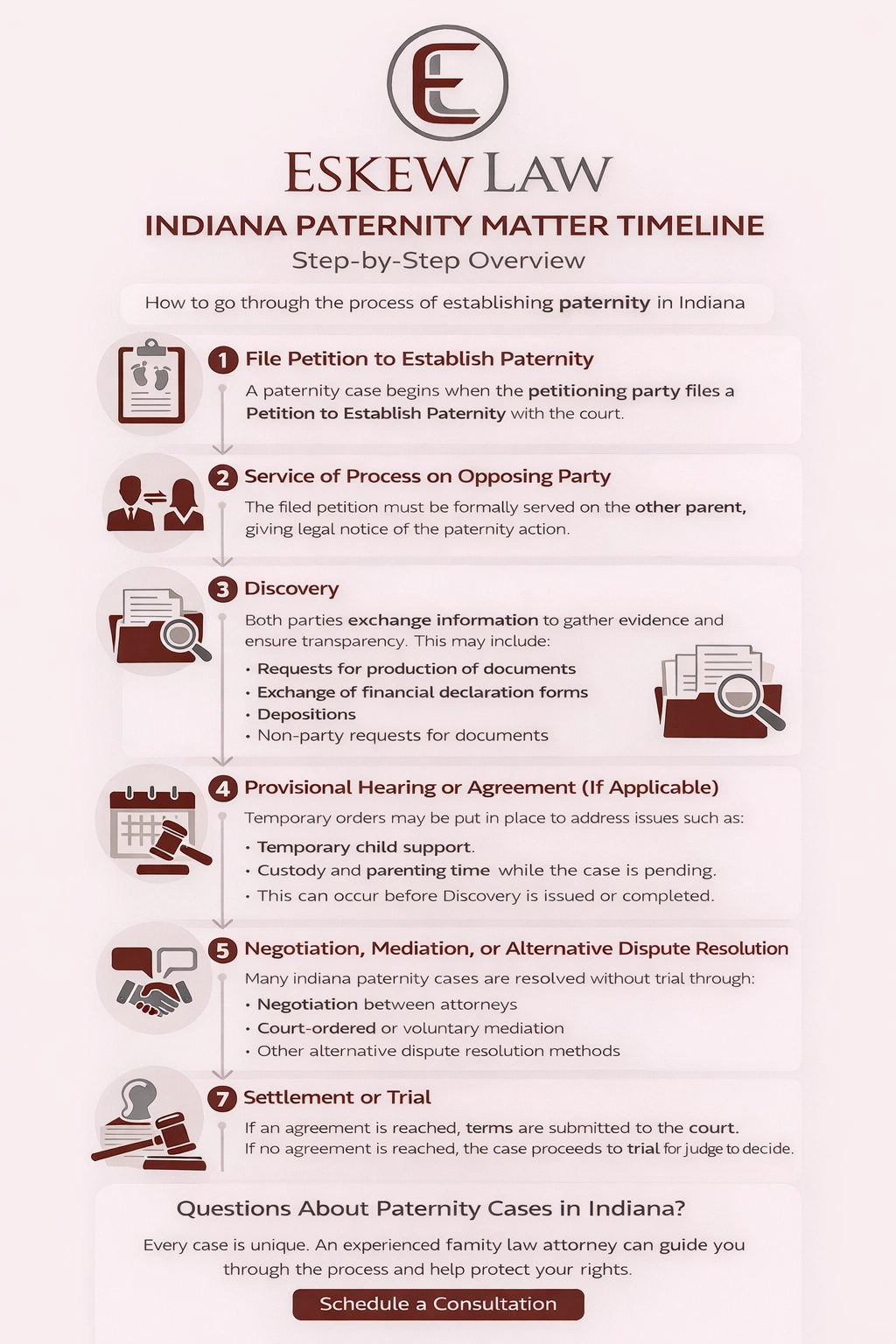
If the man contests paternity or if the parties are unsure, one of the parties may initiate a paternity action with the court, and the court can order the parties to determine paternity. This can be done through agreement, but is more commonly done through genetic testing. An accredited laboratory will swab both the child and father for DNA to determine if there is a match. Generally, the results of the DNA test will then be admitted into evidence. However, a party may object to the admissibility of DNA evidence, provided they do so within 30 days of the scheduled hearing. If they fail to raise an objection, the DNA evidence is admissible. If the DNA test confirms the man is the child’s biological father, he receives all rights and responsibilities of parenting.
Indiana paternity law also provides for a “rebuttable presumption of paternity” if a man who is not presumed to be a child’s biological father receives the child into his home and holds the child out as his biological child. While this will not necessarily result in the man being awarded paternity, it shifts the burden onto the other party to prove that the man should not be named as the child’s father.
Under Indiana Code § 3-14-5-3, a party seeking to establish paternity must file an action within two years of the child’s birth unless one of the following situations apply:
If any of these circumstances exist, a person has two years from the date the circumstance no longer exists to file an action for paternity. Do not let this time pass you by. Contact our paternity attorney in Indianapolis today to get your case started.
If paternity is established, your parental rights may include:
Fathers may also be tasked with the financial and emotional needs of the child, which include:
For additional information regarding your parental rights, you may wish to speak with an acclaimed Indianapolis paternity attorney. In addition to your rights, you also take on certain responsibilities, which include: providing basic necessities such as food, clothing, and shelter; and financially contributing toward the costs of raising the child, often through child support.
If you live within the Central Indiana area and need assistance with determining paternity or if you would like to dispute paternity, contact Eskew Law. An experienced Indianapolis paternity lawyer at Eskew Law can help you begin the process, complete the proper paperwork, and understand your options. We take this privilege and responsibility seriously for each and every one of our clients. To schedule an initial consultation, call Eskew Law or contact us online.
Meet with the attorney to discuss your legal issue. This initial meeting helps you understand their expertise and decide if they’re the right fit.
Review and sign a retainer agreement. This contract outlines the services, fees, and other essential terms.
Gather and provide all relevant documents related to your case. This step helps your attorney build your case efficiently.
Set expectations for how and when you’ll communicate with your attorney. Clear communication ensures that you stay informed throughout the process.

Facing legal issues can be very overwhelming. Defending against criminal charges, navigating a personal injury claim, and advocating for yourself during a family law case can be difficult when you’re also balancing all your other responsibilities. At Eskew Law, we know how challenging this time can be for you, and we are dedicated to making it easier for you and your family.
If you are looking for a compassionate lawyer serving Indianapolis with integrity and professionalism, look no further than Eskew Law. With over seventy-five years of experience serving clients in Indiana, we are confident that we can help you get the answers you need and reach the resolution you deserve in your case.